The short answer: A digital marketing strategy is the plan for how your business will use online channels to reach the customers you have chosen and turn them into leads and sales. Build it in this order: target market and goals first, then the role lead generation plays, then channels, then budget and measurement.
Ask a room of founders what their digital marketing strategy is and you will mostly hear a list of platforms. “We’re on Instagram.” “We run Google Ads.” “We’re starting SEO.” Those are channels. They are not a strategy, and treating them as one is a costly mistake, because it means money gets committed before anyone has decided what it is meant to achieve.
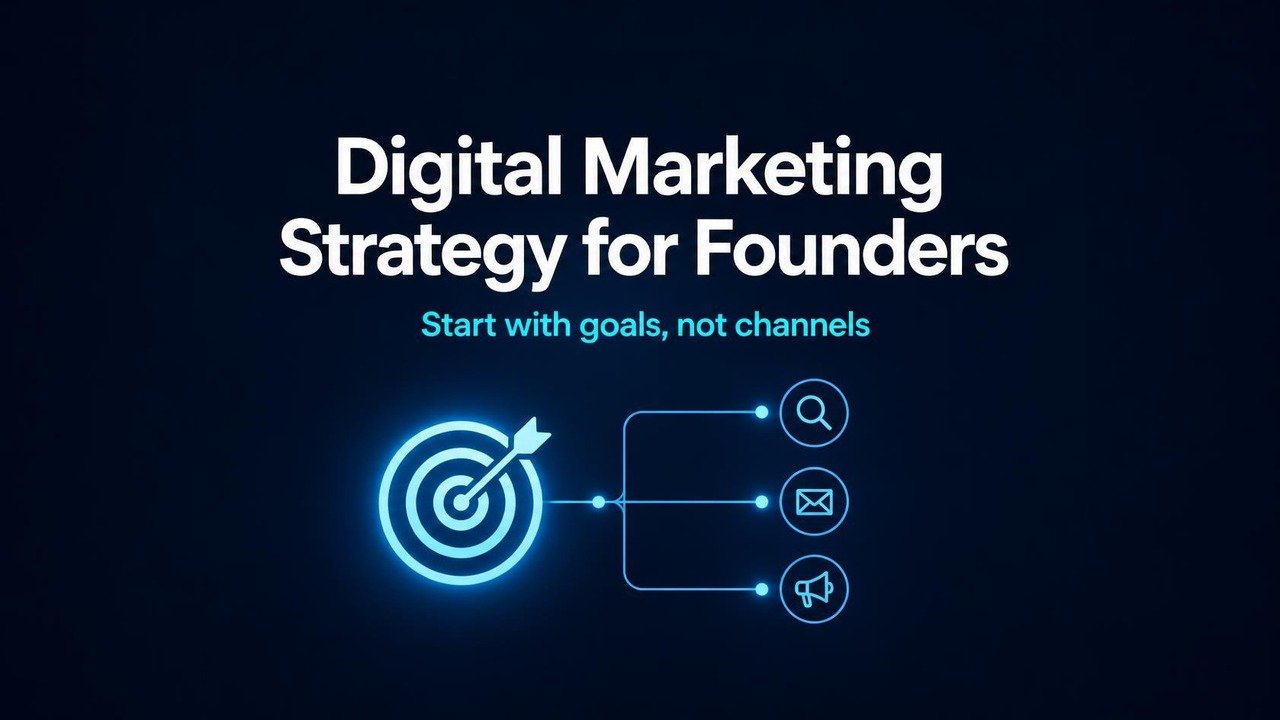
The better way round is simple to describe and harder to practise: start with goals, not channels. Decide who you want to reach and what you need from them. Then pick the few channels that can do that job, give each one a budget, and measure it against the goal you set.
This guide walks through that sequence step by step, without benchmarks or promises, so you can build a strategy that fits your business rather than someone else’s.
What is a digital marketing strategy?
A digital marketing strategy is the part of your overall marketing strategy that decides how you will use online channels, such as search, social media, paid ads, email and content, to reach your target market and meet your growth goals.
Founders ask this question often. The answer starts somewhere other than the channel list.
Why should goals come before channels?
Goals come first because a channel can only be judged against what you need it to do. Without a goal, every channel looks either promising or disappointing depending on the week, and decisions get made on impressions rather than evidence.
The U.S. Small Business Administration’s marketing and sales guide lays out a marketing plan in a deliberate order. It begins with your target market and competitive advantage, moves to your sales plan and marketing and sales goals, and only then reaches the marketing action plan, where channels are chosen. That order is the whole argument of this article in one structure.
Before you open an ad account, write down three things:
- Who you want to reach. Be specific enough that your team could recognise one of these customers.
- Why they should choose you. Your competitive advantage, in a sentence.
- What you need marketing to produce. For most growing businesses, that means a steady flow of the right enquiries for the sales team to work with.
Once those three are written, choosing channels becomes a much smaller and calmer decision.
How does lead generation fit into a digital marketing strategy?
Lead generation is usually the job your digital marketing strategy exists to do. A lead is a potential customer who has shown interest, for example by filling in a form, booking a call or replying to an email. Your channels attract attention; lead generation turns attention into conversations your sales process can handle.
Businesses are not only asking how to be seen online. They are asking how to turn being seen into enquiries.
Treating lead generation as the job changes how you design the strategy:
- Every channel needs a next step. A post, an ad or an article should lead somewhere: a page with a clear offer, a form, a booking link.
- Marketing and sales must agree on what a good lead is. If marketing celebrates volume while sales complains about quality, the strategy is measuring the wrong thing.
- Speed and follow-up matter as much as reach. The SBA’s structure puts the sales plan before the action plan for a reason: a lead that nobody follows up is wasted spend.
How do you choose the right digital marketing channels?
Choose channels by the role they can play for your target market and goals, not by popularity. Most founder-led businesses do better with a few channels run well than with many run thinly.
The table below lays out the common channels by role and by what to watch. It deliberately contains no cost or performance benchmarks, because those depend on your market, your offer and your execution, and borrowed numbers tend to mislead more than they help.
| Channel | Typical role in the strategy | What to measure |
|---|---|---|
| SEO (organic search) | Be found by people already searching for what you offer; builds over time | Visits from search to key pages, enquiries from organic traffic |
| Google Ads | Reach people searching now, on terms you choose to pay for | Cost of each enquiry, quality of enquiries reaching sales |
| Meta Ads | Put your offer in front of a defined audience that is not yet searching | Cost of each enquiry, how many leads become sales conversations |
| Social media (organic) | Build familiarity and trust with your audience; show expertise | Engagement from your target audience, enquiries that mention it |
| Content marketing | Answer your customers’ real questions; support search, social and sales | Which pieces lead to enquiries or are used in sales conversations |
| Email marketing | Stay in touch with people who already know you; nurture leads and past customers | Replies, bookings and repeat business from your list |
A practical filter for each channel is to ask three questions:
- Is my target market actually there? A channel your customers do not use is not a channel for you, however well it works for others.
- Can I sustain it? Inconsistent effort tends to produce inconsistent results. Pick what you can keep doing.
- Can I measure it against my goal? If you cannot connect a channel to enquiries or sales, you will not know whether to keep it.
Does running Google Ads help your SEO?
No. Google states in its guide Do you need an SEO? that advertising with Google does not affect a site’s presence in its organic search results. Paid and organic search are separate.
This matters for strategy because the two do different jobs on different timelines. Paid search can put you in front of searchers as soon as a campaign runs, but only while you keep paying. Organic search is earned through the quality and usefulness of your site and builds more gradually. If you want to understand that timeline better, our guide on how long Google says SEO changes take explains it.
The practical point: decide what you need from each separately. Do not expect an ad budget to lift your rankings, and do not expect organic search to fill a pipeline you need filled this month.
How should you set a digital marketing budget?
Set your budget from the action plan, line by line, rather than picking a single number and spreading it around. The SBA advises including a full budget breakdown in your marketing plan, so you can see what each part of the plan costs.
A workable approach for a founder-led business:
- List each channel and activity from your action plan. Include the people and tools needed to run it, not only the ad spend.
- Give each line a reason. Tie it back to the goal it serves. A line with no reason is the first to cut.
- Separate committed costs from tests. Some spend runs the core of your strategy; some is there to try something new. Label which is which so a test does not quietly become permanent.
- Decide in advance what you will review. Agree what evidence would make you increase, hold or stop each line.
This way, the budget becomes a decision tool, not just a cost.
How do you review and improve the strategy over time?
Build a review loop into the strategy from the start. The final section of the SBA’s marketing plan structure is to measure and update, and it suggests plans be maintained at least once a year.
A simple loop for digital marketing looks like this:
- Regularly: check each channel against the measures in your table. Are enquiries arriving? Are they the right kind? Is sales able to work with them?
- When the evidence is clear: move budget towards what is contributing to your goals and away from what is not. Change the plan, not the strategy.
- At least once a year: reread the target market, competitive advantage and goals. If those have changed, rebuild the channel choices from the top.
The discipline is the same at every stage: goal, channel, measure, adjust.
The takeaway
A digital marketing strategy is not a list of platforms. It is a short chain of decisions: who you want to reach, what you need from them, which channels can deliver that, what each will cost, and how you will know. Start with goals, not channels, treat lead generation as the job, and give every channel a reason to exist. Everything else is execution.
Frequently asked questions
What should come first in a digital marketing strategy, channels or goals?
Goals. Decide your target market, your competitive advantage and what you need marketing to produce first. Only then choose channels, because a channel can only be judged by how well it serves a goal.
Does running Google Ads help SEO?
No. Google states that advertising with Google does not affect a site’s presence in organic search results. Paid search and organic search are separate and should be planned and measured separately.
How is lead generation part of a marketing strategy?
For most growing businesses, lead generation is the main job the digital marketing strategy is built to do. Channels attract attention; lead generation turns that attention into enquiries that the sales process can follow up and convert.
How many digital marketing channels should a small business use?
There is no fixed number. A useful rule is to use only as many channels as you can run consistently and measure against your goals. For many founder-led businesses, that means a few channels done well rather than many done thinly.
What should a digital marketing budget include?
A full breakdown by channel and activity, including people and tools as well as ad spend, with each line tied to the goal it serves and a clear note of which items are tests.
Let’s build your growth system. If your digital marketing currently starts with channels, a short conversation can help you rebuild it from your goals. Schedule a Discovery Call with Agent 4 Scale.