

Picture this.
It’s Monday morning. You’ve got your coffee, your marketing person has the laptop open, and the dashboard is glowing. Impressions are up. Followers are up. Someone says the word “engagement” twice in the first minute.
Then you open the bank statement.
Revenue looks exactly like it did last month. And the month before that.
Nobody in the room is lying to you. The charts are real. The work is real. But there’s a question hanging in the air that nobody wants to say out loud: is any of this actually working?
Let’s stay in that room for a minute. Here’s what’s worth saying out loud.
The dashboard is answering the wrong question
Here’s the thing most founders get wrong. It isn’t laziness, and it isn’t a lack of data. It’s that they measure what’s easy to count instead of what they need to know.
Impressions are easy to count. So are clicks, likes and followers. They go up and down every week, and they make for a lively meeting.
But you didn’t start spending on marketing to get impressions. You started because you wanted more of the right customers, and more revenue from them.
So the first question isn’t “how did the campaign do?”
It’s simpler, and a bit more uncomfortable: did the money you put into marketing and selling bring back more money than it cost?
That’s it. That’s return on investment, ROI, said plainly. The U.S. Small Business Administration puts it in almost exactly those terms in its guide to marketing: compare your marketing and sales costs with the revenue they generate, and check that the return is positive.
It sounds obvious. So why isn’t it the first slide on a Monday?
Back to Monday
So let’s go back into that room.
You ask the uncomfortable question. Silence. Then someone says, “Well, it’s hard to say exactly. A lot of it is brand building.”
And they’re not wrong. Some of it is hard to say.
This is the moment where a marketing review can go one of two ways. Either you give up and go back to admiring the charts, or you start arguing about attribution until everyone’s tired.
There’s a third option. It’s less dramatic, and it works.
You stop trying to make the numbers perfect. You start making them consistent.
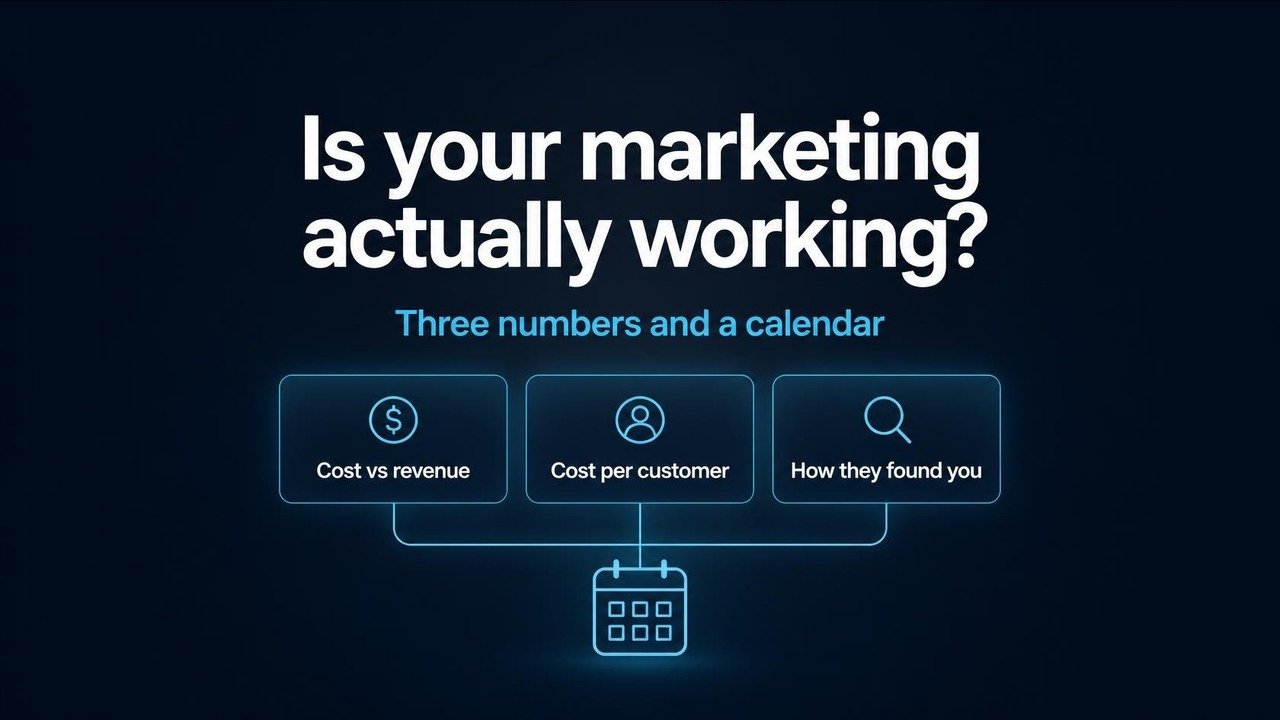
Three numbers and a calendar
If I could hand you one framework to take into tomorrow’s meeting, it would be this. Three numbers, gathered the same way every time, and a calendar that forces you to look at them.
1. What it cost, against what it brought in.
Put everything you spent on marketing and selling in one column. Not only the ad spend. The agency or freelancer fees, the tools, and the hours your own team put in. Then put the revenue that came from it in the other column, over the same stretch of time.
Is the second column bigger than the first?
Be honest about timing. Some marketing pays back weeks or months after you spend the money. That’s fine. Just compare like with like.
2. What it costs you to win one new customer.
You’ll hear people call this customer acquisition cost, or CAC. Don’t let the acronym put you off. The idea underneath it is simple: when you add up what you spend on attracting and converting people, what does it work out to for each new customer you actually win?
Why does that matter if you already know your overall return?
Because your overall return can look fine while the cost of each new customer quietly climbs. Growth can look healthy on the revenue line and still be getting harder to afford underneath. This number tells you whether the way you’re winning customers can keep going as you grow.
You don’t need a formula for this, and I’d be wary of anyone who hands you a “good” number from someone else’s business. What matters is that you decide for yourself what counts. Do you include team time? Is a new customer a first purchase, a signed contract or a paid invoice? Write it down. Then don’t change it.
A definition that shifts every quarter can’t be compared with itself. And comparison over time is the whole point.
3. How they heard about you.
Here’s where the “brand building” argument usually lands.
Some channels really are hard to measure. The SBA names print and word of mouth as examples. You can’t put a tracking link on a conversation at a dinner party.
So don’t pretend you can. Ask every new customer how they found you, and record the answer the same way every time. It’s imperfect. It’s also a steady signal, and a steady signal beats a perfect one you never collect.
If you estimate a channel’s contribution, estimate it the same way in June as you did in March. Keep your hard numbers and your judgement calls in separate columns, so nobody mistakes one for the other.
And the calendar.
None of this works if you look at it once and forget about it.
Put a regular check-in in the diary. Monthly works for most growing businesses. That’s for spend, enquiries and new customers by channel. Every few months, step back and look at cost against revenue, and at which way your cost per customer is heading. And at least once a year, which is the minimum the SBA suggests, reread the whole plan. Who you’re for, why they choose you, what you’re aiming at.
Fixed dates. Fixed numbers. One person who owns each one.
That’s KPI planning, really. Deciding in advance which few indicators you’ll watch, how each one’s defined, and who’s responsible for it, so the Monday meeting has something solid to stand on.
The turn nobody expects
Let’s go back to Monday one last time.
Say you do all of this. You’ve got your three numbers. And they tell you something interesting: enquiries are actually coming in. The right kind, even.
But revenue still hasn’t moved.
This is the part most measurement advice leaves out, and it’s the part I’d most want you to hear.
Customers don’t experience your marketing on its own. They experience your whole business. The SBA makes this point too: the way you operate, things like your returns process and your staff, shapes what customers go through.
So when the numbers look weak, before you fire the agency or switch channels, follow the lead after it arrives.
How long did it wait for a reply? Did the sales conversation match what the ad promised? Was the delivery good enough that they’d come back, or tell a friend?
Sometimes the best marketing fix isn’t in marketing at all.
It’s in the inbox nobody’s checking on a Friday afternoon.
What I’d want you to remember
You don’t need a complicated model to know whether your marketing works.
You need to compare what you spend with what comes back. You need to know what it costs to win a customer, defined once and kept steady. You need to measure the hard-to-track things consistently, not perfectly. And you need a calendar that makes you look.
Then you need the courage to look past marketing, at the business your customers actually meet.
Next Monday, try opening the meeting with the bank statement instead of the dashboard. See what changes.
A few questions you might be asking
“So what is customer acquisition cost, really?”
It’s what it costs your business to win one new customer, once you bring together what you spend on attracting and converting people. The most useful version is the one you define clearly for your own business and then keep the same over time.
“Is there a good ROI or CAC number I should be aiming for?”
Not one that fits everyone. What’s healthy depends on your margins, how long it takes to close a sale, and how long customers stay with you. Watch your own numbers, measured the same way each time, and judge them against your goals and your own trend.
“How often should I actually review all this?”
Look at spend, enquiries and new customers regularly, monthly for most businesses. Step back every few months for the bigger picture. And reread the whole strategy and plan at least once a year.
“What do I do about the channels I can’t really measure?”
Be consistent rather than precise. Ask new customers how they found you, use the same method each time you estimate, label estimates clearly, and watch how the signal moves.
“Could my marketing look like it’s failing when the problem is somewhere else?”
It can. Slow follow-up, a mismatch between what marketing promises and what sales says, or a disappointing delivery experience can all make good marketing look bad. Check what happens after the enquiry before you change anything else.
If you’re not sure which few numbers to watch, or how to define them so they stay comparable, that’s a good conversation to have before next Monday. Book a Consultation with Agent 4 Scale, and let’s set up KPIs for your growth plan.