

Here’s a moment a lot of founders will recognise. This one’s illustrative, but you’ve probably lived some version of it.
You’ve finally hired someone to help with marketing. Maybe an agency, maybe your first marketing manager. They’re keen. They sit down, open a notebook, and ask the obvious question.
“So, what’s the strategy?”
And you start talking. You know exactly who your best customers are. You know why they pick you. You know which kind of work you’d happily never do again. It all comes out, fluently, for twenty minutes.
Then they ask, “Is any of this written down?”
It isn’t. It’s in your head.
That’s not a failing. In a founder-led business, the strategy almost always starts in one person’s head. But it’s also why marketing so often feels scattered: busy one month, silent the next, and hard to judge either way. If the thinking only lives in you, nobody else can check their work against it.
The fix isn’t a forty-page document. It’s one page.
Let me give you that page.
The short version
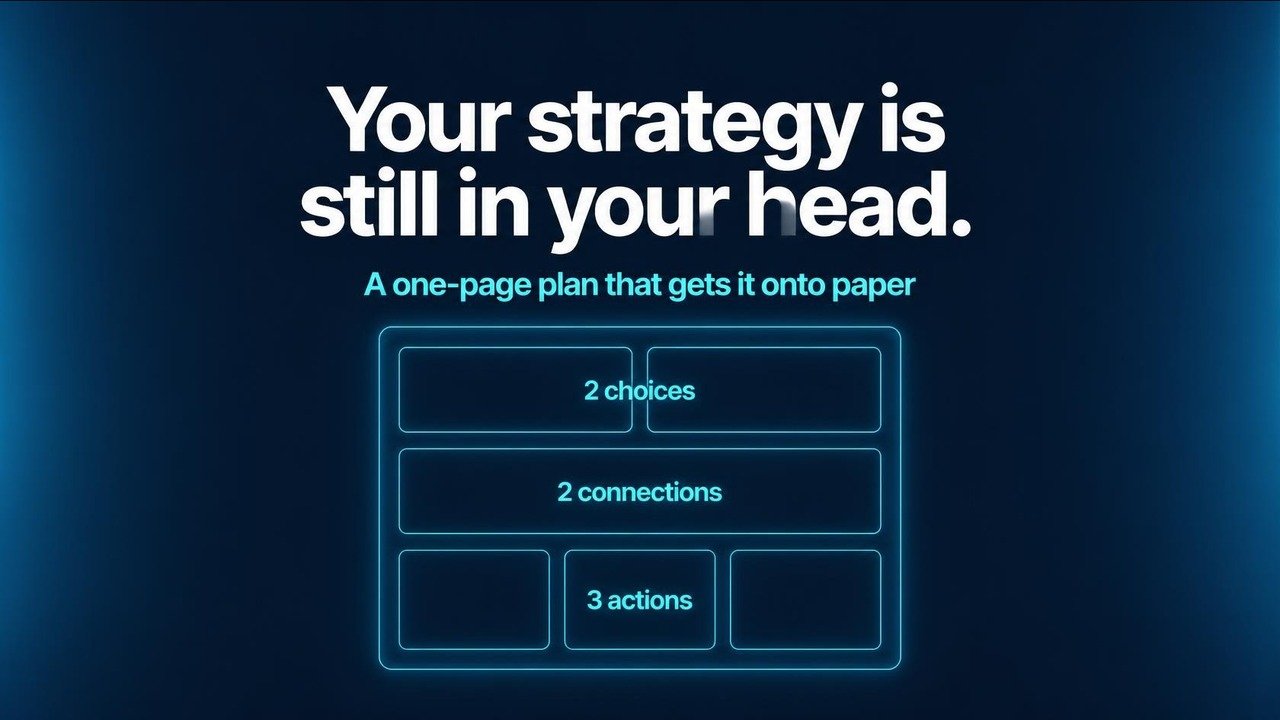
Your one-page plan has seven boxes, filled in a set order. Two boxes for your choices. Two to connect them to sales and goals. Three for the action.
I call it the 2-2-3 page. Fill each box in a sentence or two. If you can’t, that’s the box to think about first.
The seven boxes aren’t my invention. They’re the sections the U.S. Small Business Administration recommends for a marketing plan. What makes them useful is the order, and the discipline of fitting them on one page.
First, a quick word on “strategy” and “plan”
You’ll hear these used as if they mean the same thing. They don’t, and the difference matters for the page you’re about to fill in.
Your strategy is a handful of choices: who you’re for, and why they should pick you.
Your plan is what you’ll actually do about it: which channels, what budget, who owns what, and how you’ll know.
The SBA puts it neatly: “Your business plan should contain the central elements of your marketing strategy. Your marketing plan turns your strategy into action.”
That’s all the theory you need. The page does the rest.
The 2-2-3 page
Here it is. Copy it into a document, a notebook, a whiteboard. Wherever you’ll actually look at it.
| Box | Answer this in one or two sentences | Owner |
|---|---|---|
| CHOICES. 1. Target market | Who exactly are we trying to win this year, and who are we not trying to win? | |
| CHOICES. 2. Competitive advantage | Why should that customer choose us over every alternative, including doing nothing? | |
| CONNECTION. 3. Sales plan | When someone shows interest, what happens next, and who handles it? | |
| CONNECTION. 4. Marketing and sales goals | What will be different at the end of this period, and how will we know? | |
| ACTION. 5. Marketing action plan | Which channels, pricing approach, promotions and after-sale support, and why these? | |
| ACTION. 6. Budget | What will each part of the action plan cost? | |
| ACTION. 7. Measure and update | What will we review, how often, and who decides what changes? |
Now let’s walk through it the way you’d actually fill it in.
The two choices
Box 1: Target market. Write down who you want to win, closely enough that someone on your team could recognise one walking through the door.
Then write the harder half: who you’re not for.
That second line does more work than it looks. It’s what lets you say no to the tempting enquiry, the off-target channel, the campaign that looks clever but speaks to the wrong people.
Box 2: Competitive advantage. Why should that customer choose you? Not “quality” or “service”. Everyone says that. What’s the real reason your best customers came to you and stayed?
Remember to include the alternative of doing nothing. Often your biggest competitor isn’t another firm. It’s the customer deciding to put the problem off.
These two boxes are your strategy. They should change rarely, and only on purpose.
The two connections
This is where most marketing plans quietly fall apart. They jump straight from “who we’re for” to “let’s run ads”, and skip the bit in the middle.
Box 3: Sales plan. Marketing creates interest. Something has to happen next. When someone fills in a form or calls, who picks it up? How fast? What do they say?
If this box is blank, any money you spend on marketing is leaking somewhere you can’t see.
Box 4: Goals. What will be different at the end of this period? Write it so that later on you can honestly say whether you got there. “Grow the brand” won’t do. Something you can check, will.
The three actions
Only now do you get to the part most people start with.
Box 5: Marketing action plan. The SBA suggests this covers the channels you’ll use, your pricing strategy, your promotions and your post-sale support.
Notice two things.
Channels share this box with three other things. They’re one piece of the action, not the whole of it.
And post-sale support is in here. It’s the easiest one to forget, and it decides whether customers come back and send their friends.
Add one line to this box that most plans skip: why these? For every channel, write a sentence on how it reaches the people in Box 1 and serves the goal in Box 4. If you can’t write that sentence, the channel is a candidate to drop.
Box 6: Budget. Put a cost against each part of the action plan, not one big number at the bottom. When you can see where every rupee is meant to go, you can also see which line to question first.
Box 7: Measure and update. Decide now what you’ll review, how often, and who gets to call a change. The SBA advises keeping plans up to date at least once a year. Think of that as the floor, not the target.
Two habits that make the page work
A filled-in page can still end up in a drawer. Two habits stop that.
Put a name in every Owner box. A plan without owners is a list of intentions. In a founder-led business, your name might be in most of the boxes at first. That’s fine. It’s honest, and it shows you exactly which jobs need to move as the team grows.
Keep the top and the bottom moving at different speeds. Boxes 1 and 2 are your choices. Leave them alone unless something real changes: a new market, a new kind of offer, or the realisation that the customers you’re winning aren’t the ones you planned for. Boxes 5 to 7 are meant to move. If a channel isn’t pulling its weight, change the action, not the strategy.
Back to that first conversation
Picture the same meeting again. Your new marketing hire asks, “So, what’s the strategy?”
This time you slide one page across the table.
They can read who you’re for and who you’re not. They can see why customers choose you, what happens when someone enquires, what you’re aiming for, and what you’re willing to spend. They know whose name is next to what.
Twenty minutes of talking has become something they can act on, and check their own work against, long after you’ve left the room.
That’s the whole point. Your strategy doesn’t stop being yours. It just stops being trapped in your head.
A few honest questions
“Won’t one page be too simple for a real business?”
One page is where you start, not where you stop. If a box needs more detail, give it its own document. But if you can’t fill the box in two sentences, more pages won’t fix it. You haven’t made the choice yet.
“Where should this page live?”
Your strategy, Boxes 1 and 2, belongs in your business plan, next to your revenue goals. The full page should sit wherever your team will actually see it, and be pulled out at every marketing review.
“How often should I redo it?”
Revisit the whole page at least once a year. Check Boxes 5 to 7 more often against your goals, and only reopen Boxes 1 and 2 when something important about your market or business has changed.
Want help filling in the page? If your strategy still lives mostly in your head, a structured conversation is often the quickest way to get it onto paper. Book a Consultation with Agent 4 Scale, and let’s turn your growth goals into a written plan.