

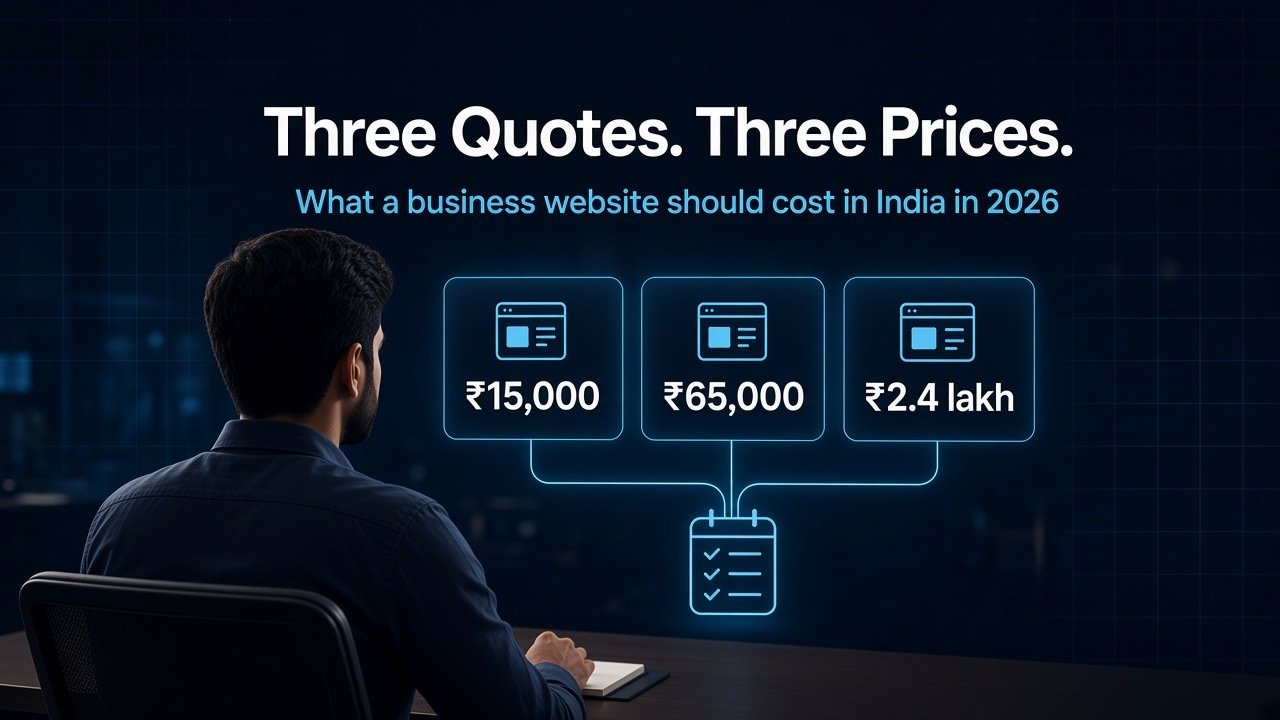
You asked three vendors for a business website. One quoted ₹15,000. One quoted ₹65,000. One sent a ₹2.4 lakh proposal with a Gantt chart. All three said “complete website”. You can’t tell whether the lowest one is a bargain or a trap, or whether the expensive one is careful or padded.
Most price guides for India won’t settle this. They are mostly written by agencies quoting their own ranges, and those ranges disagree: one calls a “basic site” ₹10,000–₹30,000, another ₹25,000–₹45,000. Almost none tell you what the site will cost you over three years, after the free first-year domain and hosting run out, or whether GST is on top.
So here’s an attempt at a neutral version. Disclosure first: Agent 4 Scale builds websites, so we have an interest. That’s why this guide shows other people’s published numbers with sources and dates, and gives you a checklist you can use on any quote, including ours.
The short answer: a simple builder site can run at a few hundred rupees a month; a basic agency site commonly starts around ₹15,000; a custom lead-generation site usually sits somewhere from ₹30,000 to ₹1.5 lakh; and an online store or web app can run from about ₹50,000 to several lakh. Add 18% GST if your vendor is GST-registered, then add three years of renewals and maintenance before you compare.
Why the published ranges disagree
The numbers disagree because they measure different things. Three reasons account for most of it:
- “Basic” means different things. One vendor’s basic site is five template pages and a contact form. Another’s includes custom design, copywriting and SEO setup.
- Most numbers come from vendors. Agencies, hosting companies and directories publish these figures, and each has something to sell. That doesn’t make them wrong, but it does mean you should read them as published asking prices, not market averages.
- What’s bundled varies. In one October 2026 review of 108 Indian agency websites, N&D Co. found that only 35 of the 101 sites they could read showed any price at all, only 2 of the 13 that priced websites said the price was one-time, and 29 of the 35 that published prices said nothing about GST (N&D Co., checked 4 Nov 2026).
So instead of averaging these ranges, it’s more useful to put them side by side by type of website.
Four bands, side by side
All prices below are published figures we checked on 4 November 2026. They are observed prices from named sources, not market averages, and most exclude GST unless stated.
| Band | What you get | Observed prices (source) |
|---|---|---|
| 1. DIY builder | You build it yourself on a hosted platform | Hostinger Website Builder Premium: ₹139/mo on a 48-month prepay (₹6,672 upfront), renews at ₹449/mo (Hostinger). Shopify Basic for stores: ₹1,499/mo billed yearly, ₹1,994 monthly (Shopify India) |
| 2. Template or basic site | 5–10 pages, mostly template-based, built for you | GoodFirms survey: ₹10,000–₹30,000 for 5–10 pages (GoodFirms). N&D Co.: median cheapest package ₹15,000. KT Solutions: ₹25,000–₹45,000 for 5 pages (KT Solutions) |
| 3. Custom lead-generation site | 10–20 pages, custom design, forms, analytics, CMS | GoodFirms: ₹30,000–₹80,000 (custom), ₹80,000–₹2,00,000 (CMS-based). KT Solutions: ₹55,000–₹95,000 for 10–20 pages. Hostinger’s guide: ₹80,000–₹1,50,000 for 10–20 custom pages (Hostinger guide) |
| 4. E-commerce or web app | Catalogue, cart, payments, or custom functionality | N&D Co.: online store packages from ₹20,000 to ₹2,67,750, median start about ₹50,000. KT Solutions: ₹65,000–₹1,40,000 for up to 100 SKUs. GoodFirms: custom web applications ₹4–25 lakh |
Read the table by row, not by cell. The spread within each row is the real information: it tells you scope is doing most of the pricing, not page count.
The seven things that actually drive the price
When two quotes for “the same website” differ by 4×, one or more of these is usually the reason:
- Design approach: a customised template versus a fully custom design.
- Who writes the content: you, or the vendor (copywriting is often billed per page).
- CMS and editability: whether your team can update pages without calling the developer.
- Integrations: CRM sync, booking, payments, WhatsApp chat, lead forms that route to sales. Hostinger’s guide puts these at ₹5,000–₹50,000 per feature, depending on complexity.
- SEO and speed setup: basic meta tags versus technical SEO, structured data and performance work.
- E-commerce depth: product count, variants, shipping rules, GST configuration.
- What happens after launch: hosting, domain, updates, backups and support. These are the costs that recur.
Think in three-year cost, not launch price
The quote you sign is only the first year. Domain and hosting are often “free” in year one and then renew, and maintenance is a recurring cost whether you budget for it or not. Hostinger’s own guide lists domain renewals at ₹500–₹1,500 a year and hosting at ₹2,000–₹8,000 a year. KT Solutions puts maintenance, domain and hosting together at ₹12,000–₹40,000 a year.
Here are three illustrative examples built from the published numbers above. They’re scenarios, not quotes.
A solo consultant on a builder. Hostinger’s Premium plan costs ₹6,672 upfront for 48 months, so the three-year platform cost is covered. Add a domain renewal after the free first year (₹500–₹1,500 a year). Total over three years: well under ₹10,000, plus your own time to build and update it. The catch: when the term ends, the plan renews at ₹449 a month, not ₹139.
A 10-page clinic site built by an agency. Say a ₹60,000 build in the middle of the custom band, plus 18% GST (₹10,800), plus ₹20,000 a year for hosting, domain and maintenance. Over three years, that’s roughly ₹1.3 lakh before GST on the maintenance. The build price is less than half of it.
A 100-product Shopify store. Shopify Basic on annual billing is ₹1,499 a month, or about ₹54,000 over three years. Add a build in the ₹50,000–₹1.4 lakh range from the sources above, plus any paid apps and payment fees. Shopify’s page lists a 2% fee on Basic when you use a third-party payment provider. The platform alone can cost as much as the build.
The pattern is the same in every case: price the outcome and the three years, not the page count.
A quick decision guide by goal
- You need credibility and contact details. A builder site or a basic template site is usually enough. Spend the difference on photos and clear copy.
- You need leads. Pay for the things that turn visitors into enquiries: clear service pages, fast mobile load, forms or WhatsApp routing to a named person, and analytics. That’s typically band 3.
- You sell products. Start from the platform (Shopify, WooCommerce or similar), then price the build around it. Compare total monthly platform cost, not just build cost.
- You need custom workflows like client portals, bookings tied to staff calendars, or dashboards. You’re buying an application, not a website. Expect band 4 pricing and a longer timeline.
Ten questions to send every vendor
Copy these into your next email. A good vendor will answer them in writing without fuss.
- How many pages, and which templates or custom designs, are included?
- Which CMS will we use, and can our team edit every page without you?
- Who writes and supplies the content and images?
- What SEO setup is included (titles, descriptions, sitemap, structured data)?
- What speed or performance standard will the site meet on mobile?
- Which integrations are included: forms, CRM, WhatsApp, payments, analytics?
- Is the price fixed, a starting price or an estimate, and is GST included or extra?
- What renews in year two and three (domain, hosting, email, licences, platform), and at what price?
- Who owns the domain, the hosting account and the code? Will both be registered in our name?
- What does maintenance (an annual maintenance contract, or AMC) cover, and what does it cost per year?
About GST
Website design and development falls under service code (SAC) 998314, “Information technology design and development services”, in the classification annexed to CBIC’s Notification No. 11/2017-Central Tax (Rate) (CBIC). That notification taxes the heading at 9% central tax (CBIC), with matching state tax, so 18% in total for a GST-registered vendor. On a ₹15,000 quote, that’s ₹2,700 more. Small vendors who aren’t GST-registered don’t charge it. If you’re registered yourself, you may be able to claim input tax credit, so ask your accountant.
Red flags
- A single lump-sum price with no line items.
- The domain or hosting registered in the vendor’s name.
- No mention of GST or year-two costs.
- “Unlimited revisions” alongside a very low price.
- No answer on who owns the code or how you’d move away later.
Frequently asked questions
Why do website quotes in India vary so much?
Because vendors are pricing different scopes and bundling different things: design approach, content, integrations, first-year hosting and GST. Compare line by line, using the ten questions above.
Is GST included in website quotes?
Often it isn’t stated. In N&D Co.’s October 2026 review, 29 of the 35 agencies that published prices said nothing about GST. Website development attracts 18% GST from registered vendors, so ask for it to be shown separately.
What does website maintenance cost each year?
Published guides vary widely: Hostinger’s guide lists ₹1,500–₹15,000 a year for outsourced maintenance on small sites, and KT Solutions puts maintenance, domain and hosting together at ₹12,000–₹40,000 a year. The right number depends on how often the site changes and what the AMC covers.
The takeaway
Don’t compare page counts. Define the outcome, ask for line items including GST and renewals, and compare three-year costs like for like.
If you’d like to talk through what your business needs from a website before you choose a vendor, book a discovery call with us.