You already sell and support customers on WhatsApp. Now a vendor is pitching “WhatsApp API automation”: chatbots, broadcasts, auto-replies. Another says the free app is fine. Meanwhile you’ve heard that Meta started charging for more messages on 1 October 2026, and you’ve seen stories about business numbers getting restricted.
Most of what ranks for this topic is written by vendors who resell access and add their own markup. Even Meta’s own pages don’t fully agree with each other right now. This guide does three things: it explains what WhatsApp actually allows, shows what Meta charges per message in India as of 1 October 2026 (taken directly from Meta’s published rate card), and helps you decide when the free Business App is enough.
App or platform: two very different products
The WhatsApp Business App is, in WhatsApp’s own words, “a free-to-download app”, built for small business owners (WhatsApp Help Center). It includes simple automation:
- Greeting messages, sent automatically when a customer first messages you, or after 14 days of inactivity (WhatsApp Help Center)
- Away messages, sent automatically when you’re busy or outside the hours you set (WhatsApp Help Center)
- Quick replies, which are saved shortcuts for messages you send often (up to 50) (WhatsApp Help Center)
The WhatsApp Business Platform (often called the “WhatsApp API”) is what CRMs, chatbots and broadcast tools connect to. Most businesses access it through a solution provider. It supports integrations and bots at scale, but Meta charges per message, and stricter rules apply.
The message categories, in plain words
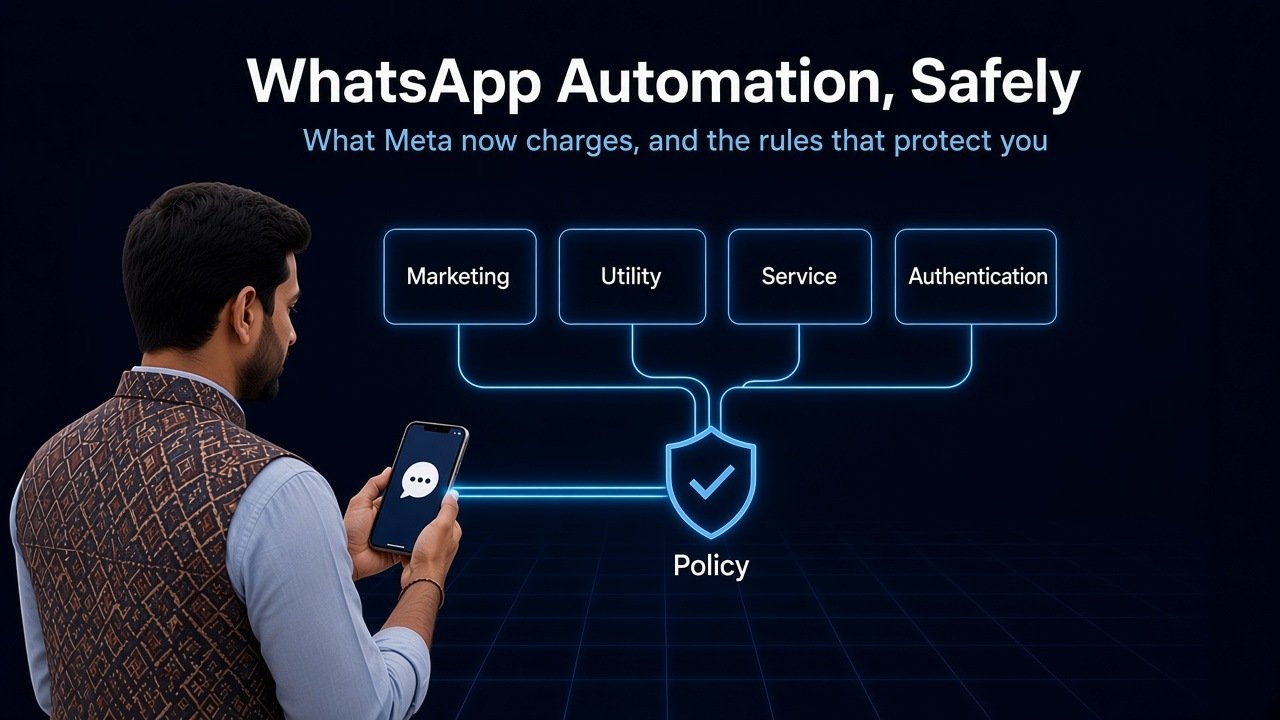
Meta’s developer documentation (updated 30 September 2026) lists five categories. Each delivered message falls into exactly one (Meta, Pricing on the WhatsApp Business Platform):
- Marketing: templates with a promotional purpose, such as offers or announcements.
- Utility: templates with a transactional or informational purpose, such as order updates or appointment reminders.
- Authentication: templates for identity checks, such as one-time passcodes.
- Service: free-form replies to a customer, typed by your team or generated by a third-party AI tool, sent within 24 hours of the customer’s last message.
- Meta Business Agent: replies generated by Meta’s own AI agent platform.
Two rules sit underneath all of this. Templates (pre-approved message formats) can be sent at any time. Free-form messages can only be sent within a 24-hour customer service window, which opens and resets each time the customer messages you.
What Meta charges in India (rate card effective 1 October 2026)
Below are the India rates from Meta’s official INR rate card, linked from the developer pricing page. We checked them on 4 November 2026. They’re charged per delivered message.
| Category | Rate per delivered message (India) |
|---|---|
| Marketing | ₹0.8631 |
| Utility | ₹0.115 |
| Authentication | ₹0.115 |
| Authentication-International | ₹2.4971 |
| Service (after the free monthly tier) | ₹0.115 |
| Meta Business Agent | US\$2.00 per million tokens (Meta estimates about 4–5 US cents per message) |
Meta’s rate card doesn’t mention taxes, and your solution provider will usually add its own fees. Ask your provider for an all-in price, including GST, before you sign.
Meta says it may change prices only on the first day of a quarter (1 January, 1 April, 1 July or 1 October), so check the rate card again before each quarter.
What changed on 1 October 2026
According to Meta’s developer documentation:
- Service messages are charged again, after a free tier of 1,000 service messages per business phone number per month. Unused free messages don’t roll over.
- Utility messages sent inside the 24-hour customer service window are now charged. They had been free since 1 July 2025.
- Free entry point window: if a customer messages you from a Click-to-WhatsApp ad and you reply within the service window, Meta doesn’t charge for marketing, utility, authentication or service messages to that person for up to 7 days. Meta Business Agent messages are still charged.
- Businesses without a payment method on file may find their service messages stop being delivered once the free tier is used up.
- Indian businesses must move to INR billing by 31 December 2026. From 1 January 2027, Meta says it will stop delivering messages from eligible accounts that haven’t migrated.
A note on conflicting information. When we checked Meta’s WhatsApp Business marketing page on 4 November 2026, it still said “we do not charge for service messages, or for utility messages businesses send in response to users”. It also described the free window after an ad click as “3 days (72 hours)” (WhatsApp Business, platform pricing). Meta’s developer documentation, updated 30 September 2026, and its rate card effective 1 October 2026 say otherwise, as summarised above. The developer documentation is more detailed and more recent, so we’ve used it here. If you’re budgeting, confirm with your provider which rules they’re billing against.
Rules that get accounts restricted
From the WhatsApp Business Messaging Policy (last updated 23 September 2026) (WhatsApp):
- Opt-in first. Only message people who have given you their number and agreed to receive messages from you.
- Templates to start conversations. On the Platform, conversations you start must use an approved template. Free-form replies are only allowed within 24 hours of the customer’s last message.
- A route to a human. If you automate, you must offer a clear way to reach a person, such as a human agent, phone number, email, web form or store.
- Respect opt-outs. If someone asks you to stop, stop.
- Restricted categories. The policy prohibits using WhatsApp for Business to buy, sell or promote certain regulated goods and services (the list includes alcohol and tobacco, and medical and healthcare products), with limited exceptions in some countries.
- Health information. The policy says not to use WhatsApp to send or request health information “if applicable regulations prohibit” it.
- Negative feedback. Meta may limit how many messages you can send, or remove access, if users block or report you in significant numbers.
India’s data protection law points the same way on consent. The Digital Personal Data Protection Act, 2023 (s.6) says consent must be “free, specific, informed, unconditional and unambiguous with a clear affirmative action”. Most obligations under the DPDP Rules, 2025 are scheduled to apply 18 months after the Rules were notified in November 2025. Ask your legal adviser how this affects the way you collect numbers.
A worked example: what a month might cost
These volumes are illustrative, not typical. The rates are Meta’s India list rates from 1 October 2026.
| Messages in a month | Calculation | Meta charge |
|---|---|---|
| 5,000 marketing templates (a festive offer) | 5,000 × ₹0.8631 | ₹4,315.50 |
| 3,000 utility templates (order updates) | 3,000 × ₹0.115 | ₹345.00 |
| 2,500 service replies on one number | First 1,000 free; 1,500 × ₹0.115 | ₹172.50 |
| Total | ≈ ₹4,833 + GST and provider fees |
Two things stand out. First, marketing messages make up almost 90% of the bill, so who you broadcast to (and whether they opted in) drives cost as much as compliance. Second, everyday service replies cost little at this volume. Meta also offers volume tiers for utility and authentication messages, so high-volume senders may pay less per message.
Three examples
- A D2C brand sending order updates: utility templates. The cost per message is low, but check the volume tiers if you send thousands.
- A clinic sending appointment reminders: also utility, but take extra care. Keep messages to scheduling and avoid health details, given the policy’s health-information rule.
- A festive offer broadcast: marketing templates, sent only to people who opted in. Expect this to be your largest line item.
Decision checklist: app or platform?
Stay on the free Business App if most of these are true:
- One or two people reply to customers from a phone.
- You send fewer messages than a person could manage by hand.
- Greeting messages, away messages and quick replies cover your automation needs.
Move to the Platform, through a provider, if you need:
- Several team members on one number, or replies from a CRM
- Automated order, booking or delivery updates
- A chatbot for common questions (with a route to a human)
- Broadcasts to large opted-in lists
Before you sign with a provider, ask for an all-in price per category, including GST, any monthly platform fee, and who owns the number and the opt-in records.
Frequently asked questions
Is the WhatsApp Business App free?
Yes. WhatsApp describes it as a free-to-download app for small businesses. It includes greeting messages, away messages and quick replies. Per-message charges apply to the WhatsApp Business Platform, not the app.
How much does a marketing message cost in India?
₹0.8631 per delivered message on Meta’s India rate card effective 1 October 2026, before taxes and provider fees. Check the rate card each quarter.
Can I message customers who haven’t opted in?
No. WhatsApp’s Business Messaging Policy only allows you to contact people who have given you their number and agreed to receive messages from you.
The takeaway
Automate the routine messages, keep a human reachable, and budget by message category. Start with the free app, and move to the Platform when your volume or integrations need it.
If you’d like a second opinion on your setup, book a consultation and we’ll help you plan a compliant WhatsApp setup through an official provider.