

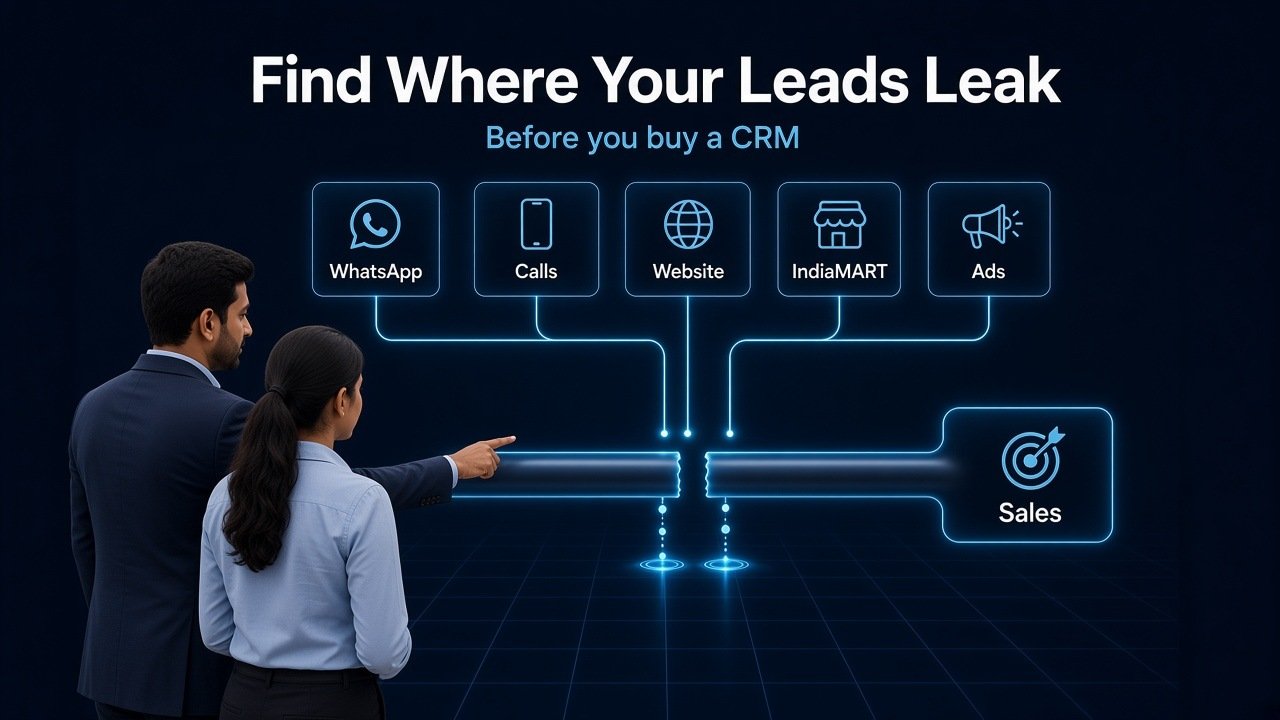
Enquiries are coming in through WhatsApp, missed calls, the website form, IndiaMART or JustDial, and the ad campaign you’re paying for. But sales isn’t moving. Your team says the leads are poor quality. Marketing says sales doesn’t follow up. You don’t actually know which is true.
Most advice on this jumps straight to “buy a CRM” or “respond in five minutes”, often quoting statistics with no source. It also tends to ignore how enquiries really arrive in India: on WhatsApp, where Meta has firm rules about when and how a business can message someone.
This guide does it in a different order. First, find out where leads are leaking, with a simple audit you can do in a spreadsheet. Then fix speed, cadence and ownership. Only after that, decide what to automate.
Step 1: Run a lead leak audit before you buy anything
Pick the last 30 to 50 enquiries. For each one, fill in five columns:
| Column | What to record |
|---|---|
| Source | WhatsApp, call, website form, IndiaMART, JustDial, ad, referral |
| First response time | How long until a human (or useful auto-reply) replied |
| Owner | The one person responsible for this lead |
| Next step | The agreed next action and date (“send quote Tue”, “site visit Sat”) |
| Outcome | Won, lost (with reason), or still open |
Patterns usually jump out within an hour of doing this. Blank “owner” cells mean leads that belong to everyone, and therefore to no one. Blank “next step” cells mean conversations that ended without anyone deciding what happens next. Long response times clustered on one source (say, weekend form fills) show you where to fix first.
Doing this before buying a tool matters. A CRM records a process; it doesn’t create one. If you don’t know where leads leak, you’ll just automate the leak.
Step 2: Respond fast, but set a target your team can keep
The most-cited evidence on response speed comes from a 2011 Harvard Business Review article by Oldroyd, McElheran and Elkington. It reported two separate pieces of research, which often get mixed up:
- An audit of 2,241 US companies that received web enquiries: 37% responded within an hour, 24% took more than 24 hours, and 23% never responded at all. Among companies that responded within 30 days, the average response time was 42 hours.
- An analysis of 1.25 million leads at 42 US companies (29 consumer-facing and 13 B2B): firms that tried to contact a lead within an hour were nearly 7 times as likely to qualify it (have a meaningful conversation with a decision-maker) as firms that waited even an hour longer, and more than 60 times as likely as firms that waited 24 hours or more.
Two honest caveats. This is US data from over a decade ago, and it measures qualifying a lead, not closing a sale. It shows a strong association, not proof that speed alone causes sales. We haven’t found comparable published data for Indian small and mid-sized businesses. Still, the direction is clear, and it matches common sense: people enquire with several businesses at once, and the first useful reply tends to frame the conversation.
A realistic target: rather than a “5 minutes, 24/7” promise nobody can keep, set a service level your team can actually meet. For example:
- An immediate acknowledgement (automated is fine) for every enquiry, at any hour.
- A human reply within one business hour during working hours.
- Enquiries received after hours answered first thing the next business morning.
Write it down, tell the team, and measure it every week.
Step 3: Follow a simple cadence: Day 0, 1, 3, 7
Most leads don’t decide on the first contact, and most teams stop after one or two attempts. A light, predictable cadence fixes that without being pushy:
- Day 0: Reply and answer the actual question. Agree a next step.
- Day 1: A short follow-up on the channel they used. Add something useful, like a brochure, a price range, or available slots.
- Day 3: Try a second channel (a call if they messaged, a message if they called).
- Day 7: A polite “should I close this for now?” message. This often gets a reply, either yes or “not yet, check back next month”.
After Day 7, move the lead into a slower nurture rhythm (for example, a useful update once a month) only if they’ve agreed to hear from you. Record the reason when a lead goes cold. “Price”, “timing”, “went with competitor” and “never replied” each call for a different fix.
Step 4: Give every lead one name
Ownership is the cheapest fix there is. Every lead gets exactly one person’s name the moment it arrives. That person owns the next step, even if someone else does the work. Shared inboxes and group WhatsApp chats are where leads quietly die, because everyone assumes someone else replied.
Step 5: Automate the safe parts, keep people on the rest
Automation helps most where the task is repetitive and the risk of getting it wrong is low.
Safe to automate:
- Immediate acknowledgement (“Thanks, we’ve received your enquiry. [Name] will reply by [time].”)
- Routing a lead to its owner and alerting them
- Reminders to the owner when a next step is due
- Appointment or site-visit confirmations and reminders
Keep with a person:
- Qualifying the lead: understanding the need, budget and timeline
- Pricing, discounts and negotiation
- Handling complaints or anything sensitive
Step 6: Know the WhatsApp rules before you scale
If you use the WhatsApp Business Platform (the API version that tools and CRMs connect to), Meta’s Business Messaging Policy sets clear rules (WhatsApp Business Messaging Policy, last updated 23 September 2026):
- Opt-in first. You may contact people only if they’ve given you their number and agreed to receive messages from you.
- The 24-hour window. When a customer messages you, you can reply freely for 24 hours. Each new message from them resets the window.
- Outside the window, templates only. After 24 hours, or to start a conversation, you must use a pre-approved message template.
- Give people a way to a human. If you use automation, you must provide a clear route to a person, such as a human agent, phone number, email, or web form.
- Respect opt-outs. If someone asks you to stop, stop.
Practically, this means your Day 1 follow-up on WhatsApp is easy if the lead messaged you yesterday. Your Day 7 message will usually need an approved template, sent only to someone who opted in. Plan your templates in advance. Meta also charges per message for some template categories, so check Meta’s current pricing for India before scaling up.
Three illustrative examples
These are illustrations of how the system applies, not client results.
A clinic getting WhatsApp enquiries. Most messages arrive in the evening. The audit shows replies often come the next afternoon, and no one owns follow-up. Fix: an automatic reply with clinic hours and a booking link, one named front-desk owner, and a first-thing-morning reply rule. Health-related messaging may have extra legal limits, so the clinic keeps WhatsApp to scheduling and avoids sharing health details there.
A B2B manufacturer with IndiaMART leads. Lots of volume, many low-intent enquiries. The audit shows sales chases every lead equally, and quotes go out without a follow-up date. Fix: a quick qualification question on Day 0 (quantity, timeline), a named owner per lead, and a Day 3 call for anyone who received a quote.
A real-estate developer booking site visits. Visits are booked but many don’t happen. Fix: an automated confirmation and a reminder the day before, a human call to confirm on the morning of the visit, and a “reason lost” field to see whether no-shows cluster on a particular source.
Step 7: Review it weekly, in 20 minutes
Once a week, look at four numbers:
- Median first response time: in business hours, by source.
- Contact rate: the share of leads where you actually reached a person.
- Conversion by source: which channels produce customers, not just enquiries.
- Reasons lost: the top three, and what you’ll change.
That’s it. Twenty minutes, the same four numbers, one change per week. Over a quarter, this tells you far more than arguing about lead quality.
Frequently asked questions
How fast should we respond to a new lead?
As fast as you can reliably manage. Research from HBR (2011) found that trying to contact a lead within an hour made qualifying it far more likely than waiting longer. A practical target is an immediate acknowledgement, then a human reply within one business hour.
How many times should we follow up?
A simple cadence of Day 0, 1, 3 and 7, across at least two channels, then a slower nurture rhythm only for people who agreed to hear from you. Record why each lead was lost.
Can we message a lead on WhatsApp after 24 hours?
On the WhatsApp Business Platform, only with a pre-approved message template, and only if the person has opted in to hear from you. Within 24 hours of their last message, you can reply freely.
The takeaway
Most “bad leads” problems are really follow-up problems: slow first replies, no owner, and no next step. Audit first, fix speed, cadence and ownership, then automate the safe parts.
If you’d like help finding where your enquiries go cold, schedule a discovery call and we’ll map your lead leaks with you.